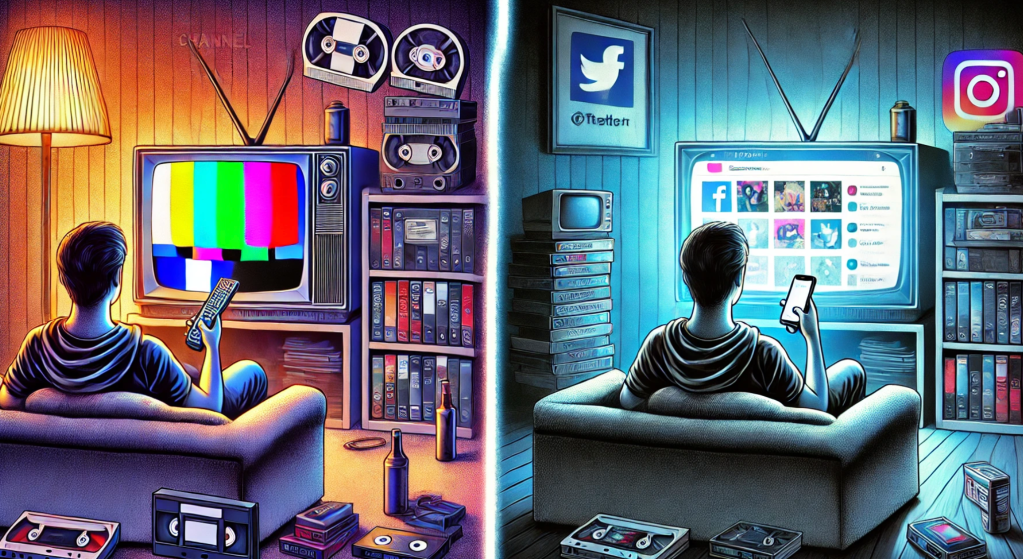
Once upon a time, we ruled the remote. It was an era when the glow of a boxy television filled our living rooms, and “channel surfing” wasn’t just a pastime, it was a ritual. You plopped down on the couch, remote in hand, and embarked on a journey through the vast wasteland of cable television. Maybe you were searching for something specific, but more often than not, you were just flipping, aimlessly drifting through an ocean of content, never quite satisfied, never quite stopping.
That experience, that act of endlessly flipping through channels, has not disappeared, it has evolved. Today, instead of pressing “Channel Up” on the remote, we swipe up on our screens. Instead of discovering a rerun of Seinfeld sandwiched between infomercials and local news, we stumble upon a 15-second cooking hack followed by a cat wearing sunglasses. Social media platforms like TikTok, Instagram Reels, YouTube Shorts, and Facebook Videos have resurrected the essence of channel surfing, only now, we don’t just scan for entertainment, we get force-fed an endless stream of it.
Same Habit, New Medium
Back in the day, channel surfing was an exercise in patience. There was no “instant access” to exactly what you wanted. Sure, you had a TV Guide, but good luck finding something on-demand. You had to work for your entertainment, sifting through the static until you landed on something remotely interesting. Today, we’ve eliminated the middleman. If you want to watch a specific movie or show, it’s available at the tap of a button on Netflix, YouTube, or Prime Video. No waiting, no flipping, just direct access.
But despite this advancement, we still engage in the same old habit, only now, it’s in micro-doses. Social media scrolling is, at its core, just an ultra-fast version of channel surfing. You don’t go looking for a specific video; you open the app and let the content come to you. But the fundamental behavior is unchanged: a clip catches your attention, holds it for a few seconds, and then, inevitably, you swipe up. The cycle repeats. Just like before, you’re always chasing that next hit of entertainment, always wondering if something better is just one more flip away.
More Control, Less Satisfaction?
At first glance, social media scrolling seems superior to old-school channel surfing. The algorithm learns what you like and tailors content accordingly, whereas TV never cared if you actually wanted to see a commercial for laundry detergent. But has this algorithmic precision made us more satisfied? Or just more restless?
With traditional channel surfing, there was an element of surprise. You might have started out looking for a sitcom and ended up watching a documentary about deep-sea creatures at 2 AM. There was an inherent randomness to it, a sense of accidental discovery. Today’s social media feeds eliminate that randomness in favor of endless, hyper-curated content. The result? We’re stuck in loops of sameness. If you engage with a few videos about camping, suddenly your entire feed is camping, until you’re sick of it. The old channel surfing, for all its randomness, at least gave you variety. Social media’s version, despite being customized for you, can sometimes feel like being trapped in an echo chamber.
The Paradox of Infinite Choice
We used to complain about cable packages with 300+ channels, saying “there’s nothing on.” Now, we have infinite content at our fingertips, and we’re still saying the same thing. The problem isn’t availability, it’s attention span. When we channel surfed, we stayed on something longer, if only because it was a hassle to keep flipping. Now, with social media, our patience has shrunk to mere seconds. We are never truly engaged, only momentarily distracted.
And maybe that’s the real revelation here: It’s not that technology has changed how we consume entertainment; it’s that it’s changed our tolerance for boredom. Channel surfing at least required a bit of commitment. Social media gives us an easy out, over and over again, until we barely remember what we just watched.
Conclusion: Have We Really Changed?
So, is social media just the modern evolution of channel surfing? Absolutely. But in many ways, it’s a hyperactive, overstimulated version of it. We aren’t just flipping through channels, we’re cycling through dopamine hits at an unprecedented speed. And yet, the core behavior remains: we are always looking for the next thing, always searching, never settling. The medium has changed, but the human need to discover, to browse, to escape for just a little while, remains the same.
Maybe the real question isn’t whether social media is just a digital version of channel surfing. Maybe the question is: Are we actually enjoying it? Or are we just flipping forever, hoping to find something that finally makes us stop?



 Gary W. Phipps II
Leave a comment