
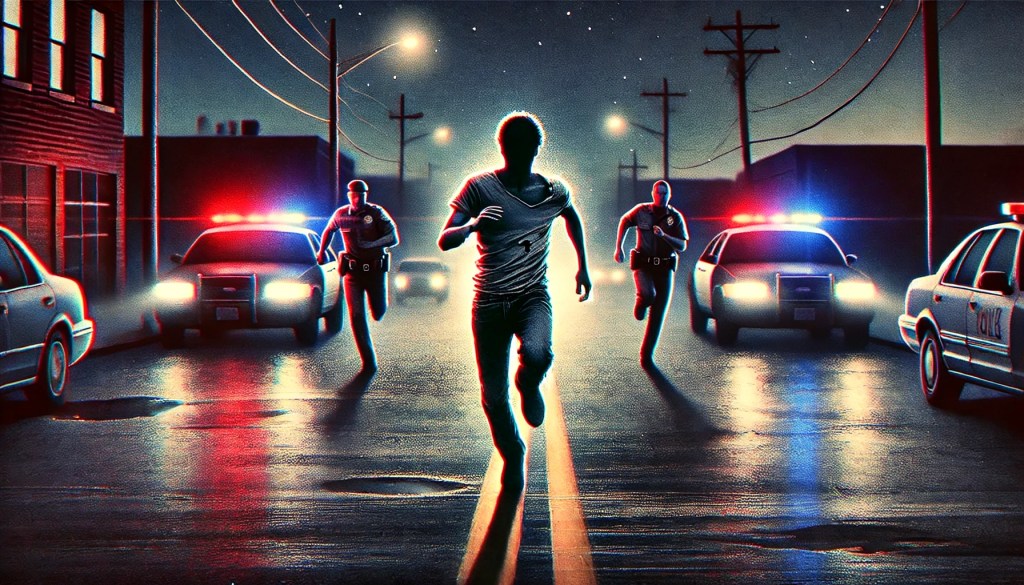
Lately, my wife and I have been on a tear, absolutely devouring episode after episode of Cops on Pluto TV. It’s free, which is great, but comes with a grueling number of commercials—almost as relentless as the police chases themselves. Still, we power through. We’re probably 50+ episodes deep at this point, and it’s safe to say I’ve become something of an armchair expert on the behaviors of degenerates, the chronically unlucky, and the profoundly stupid.
At first, Cops feels like simple, brain-dead entertainment. Some shirtless dude with a neck tattoo tries to convince an officer that the crack pipe in his sock isn’t his, a wasted guy on a bicycle crashes into a mailbox, and someone with “only two beers” in their system blows a .26 on a breathalyzer. It’s the kind of late-night programming that makes you feel, by comparison, like a responsible and thriving member of society. But after bingeing it for weeks, I’ve come to realize something: Cops is basically an unsanctioned, unintentional crash course in human behavior.
You start to see the patterns. The way people react when they’re caught in a lie. The stammering, the over-explanations, the sheer audacity of some folks who think they can out-talk their way out of a DUI when their speech sounds like a dial-up modem. Then there’s the ones who just run—darting off like drunk gazelles, only to be taken down by some officer who clearly ran track in high school. It’s almost like a nature documentary, except instead of majestic lions hunting wildebeests, it’s a guy with no shirt and an outstanding warrant getting tackled into a muddy ditch.
But beyond the comedy of bad decisions and obvious guilt, there’s also an uncomfortable realization: Cops is basically a gladiator show for modern audiences. The ancient Romans packed coliseums to watch poor, desperate people get mauled by lions; we sit on our couches watching poor, desperate people get taken down by tasers. A lot of these folks are at the absolute worst moment of their lives—high, broke, or just plain screwed—and we’ve built an entire entertainment industry around it. The show thrives on failure, on the sheer spectacle of watching someone’s life fall apart in real-time.
There’s something deeply sad about that. These people aren’t movie villains or scripted characters; they’re real. That guy getting dragged out of a car because he fell asleep at a green light? He’s somebody’s brother, somebody’s son. That woman trying to convince the cops that the meth in her bra belongs to “some other girl” is somebody’s mother. And while it’s easy to laugh (because, honestly, some of it is hilarious), you also realize that Cops is a mirror of sorts—reflecting a society where some people make mistakes and pay dearly for them, while others get to sit back and enjoy the show.
After watching enough of these episodes, I’ve started thinking: shouldn’t someone smarter than me be studying this? Like, professionally? A deep dive into the human behaviors displayed on Cops—the body language of guilt, the psychology of the chase, the economic and social patterns of repeat offenders—would be fascinating. Is it sociology? Economics? Criminology? Whatever the right field is, someone should get on it, because I guarantee there are PhD-level insights buried in the footage of 30 years’ worth of bad decisions.
Until then, my wife and I will probably just keep watching, shaking our heads, and mentally cataloging the next batch of common excuses, bad bluffs, and tragic, inevitable arrests.
Maybe that’s the real lesson of Cops: If you can’t be good at life, at least be entertaining enough to make the final cut.



 Gary W. Phipps II
Leave a comment